Reinventing custom detections and vulnerability management
Summary
- Collected
📦 Full-Text Content Snapshot
R2 Archive · Full Article PreservedProjectDiscovery Team · Announcements · Source: projectdiscovery.io
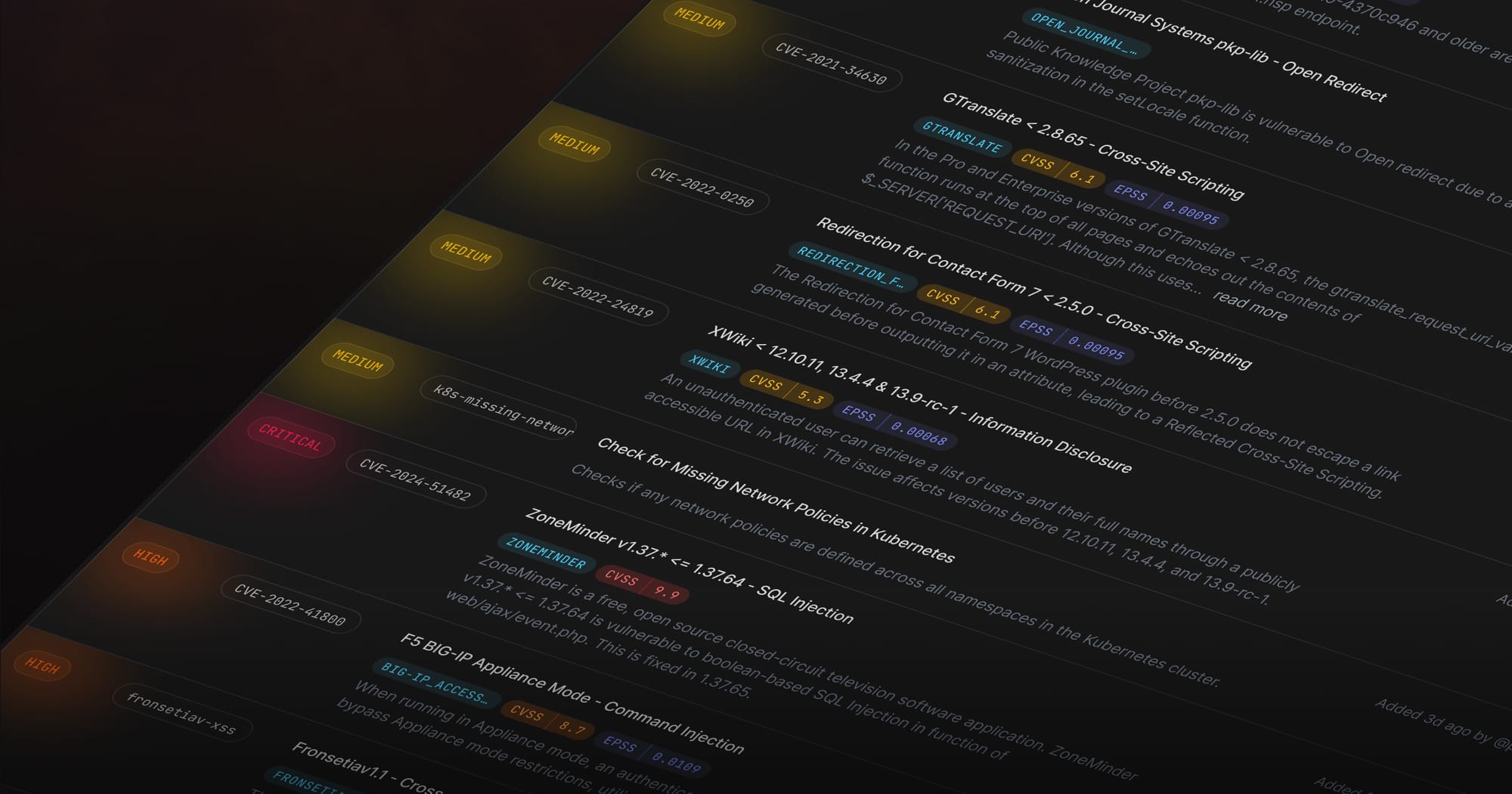
Nuclei has become a cornerstone of modern security testing, empowering researchers, red teams, and enterprises to detect exploitable vulnerabilities with precision. The security community loves it for its accuracy, transparency, and unparalleled customizability, offering users the ability to define their own detections using simple YAML-based templates.
For those new to Nuclei, it’s an open-source vulnerability scanner that thrives on community-driven intelligence. Its template-based approach makes it incredibly flexible, allowing users to write detections for virtually any security risk, from misconfigurations to zero-day exploits.
Last year, we introduced the AI Template Editor, and the response was incredible with over 40 thousand templates created.
Today, with ProjectDiscovery v1, we’re making it even easier to create and manage custom Nuclei templates. From improvements to the AI Template Editor to automating how security teams monitor for regressions, we’re committed to helping security teams protect their organizations from every type of security risk.
And while we continue to invest in our AI experience, one thing remains unchanged: your prompts and templates belong to you. We do not train on any user inputs, ensuring a privacy-first AI experience.
TL;DR
- Smarter AI Template Editor – Now with iterative testing and built-in validation to reduce false positives and generate more accurate templates.
- External data integration – AI can now reference external URLs like NIST NVD, CVE databases, and vulnerability writeups for more context-aware templates.
- Higher context limits – Increased prompt capacity allows for more complex detections, reducing back-and-forth adjustments.
- Full-text search for public templates – Search across the entire YAML content of Nuclei templates, including metadata, comments, and protocol definitions.
- New
aiflag in Nuclei CLI – Generate and execute templates on the fly for quick, targeted scans without needing a pre-written template. - Introducing Auto-Regressions – Streamline vulnerability retesting and regressions with ticketing platforms like Linear, Jira, and ServiceNow to automate vulnerability lifecycle management.
Iterative Testing and Built-In Validation
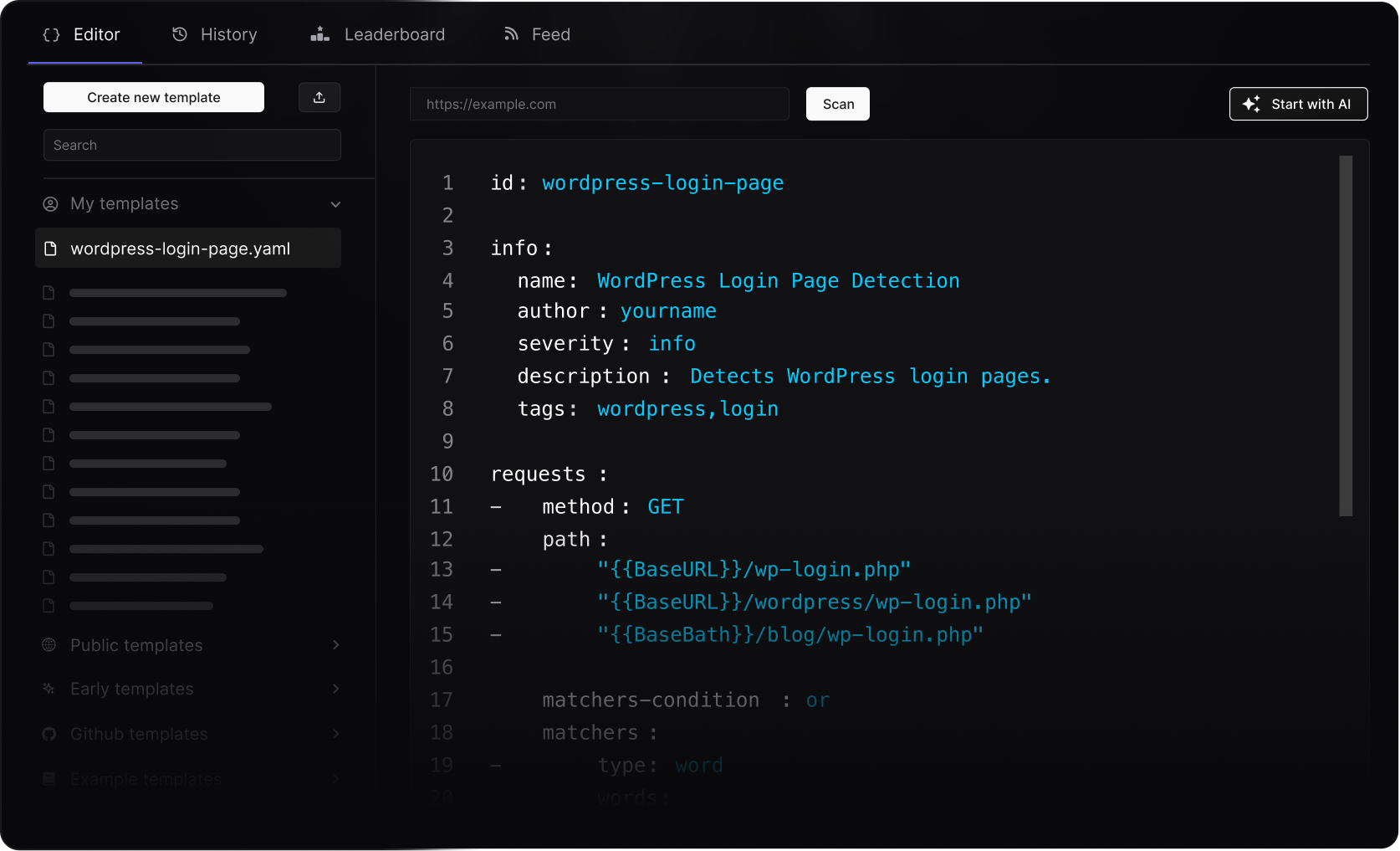
We're excited to introduce major enhancements to our AI Template Editor, focused on iterative testing and built-in validation to make template creation more accurate and reliable than ever.
Key Enhancements:
- Iterative validation: The AI Template Editor now performs multiple iterations against a target to ensure that the final Nuclei template is valid, functions correctly, and accurately reflects your initial prompt.
- Response data verification: By analyzing response data, the editor confirms that the correct patterns are matched, ensuring the template's effectiveness.
- Thorough logic testing: Before finalizing the template, the AI generator rigorously tests its logic, resulting in significantly fewer false positives and more accurate detections.
Our improved AI Template Editor is available for everyone to try here.
AI Template Editor Now Supports External Links
curl --request POST \
  --url https://api.projectdiscovery.io/v1/template/ai \
  --header 'Content-Type: application/json' \
  --header 'X-API-Key: <api-key>' \
  --data '{
  "prompt": "Visit @example.com/api/server-info@ and extract the necessary information to generate a Nuclei template for detecting sensitive info leaks. The template should send a GET request to the endpoint and include matchers to capture leaked data such as IP addresses, server software versions, exposed email addresses, API keys, or database connection strings from the JSON response. Include detailed matcher configuration to accurately detect these sensitive patterns."
}'
The AI Template Editor now has the ability to access and analyze external URLs directly from your prompts. Instead of relying solely on user-provided input, the AI can reference official documentation, vulnerability reports, and security databases to generate more precise templates with minimal manual effort.
With support for external resources, the editor can pull in relevant data from sources like NIST NVD, CVE databases, framework documentation, and vulnerability write-ups. This allows for more accurate, context-aware template generation without overflowing the prompt field.
This new capability is available in both the UI and our API.
Expanded Context Windows for More Complex Detections
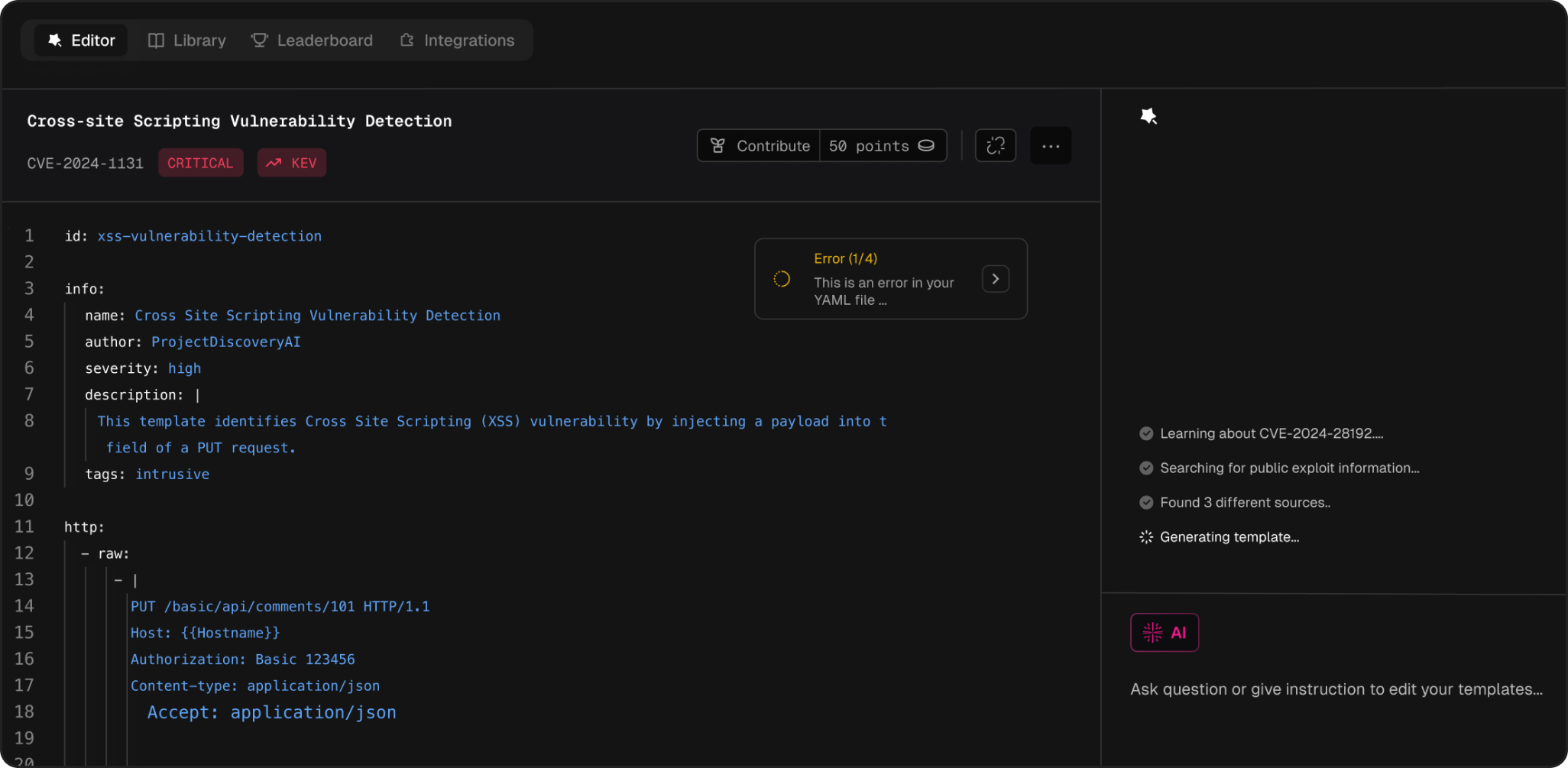
After listening to user feedback, we’ve increased the context window for AI-generated templates, making it easier to work with more complex vulnerability scenarios.
With this update, you can now include larger datasets (logs, tracebacks, and multiple examples) without hitting prompt limits. This is especially useful for handling multi-step vulnerabilities that require state-based validation or multi-attack-vector checks. Whether you're detecting XSS, SQL injection, or multi-protocol misconfigurations, the expanded context capacity streamlines template creation by reducing the need for iterative adjustments.
Introducing the ai Flag in Nuclei CLI
Beyond the AI Template Editor, we’re introducing a new way to leverage AI within Nuclei — directly from the command line. With the new -ai flag in Nuclei CLI, users can execute quick, AI-powered detections on the fly without needing predefined templates.
How It Works
Simply append the -ai flag to your Nuclei command, followed by a natural language query specifying what you want to detect. The feature dynamically generates a Nuclei template based on your prompt and executes it in real-time.
Example Use Cases
Check for sensitive information leaks in API responses:
nuclei -list targets.txt -ai "Find admin_api_key in response"Spot debug error messages revealing stack traces:
nuclei -list targets.txt -ai "Detect exposed stack traces in error messages"Identify admin panel endpoints dynamically:
nuclei -list targets.txt -ai "Find admin login endpoints"Find hardcoded secrets in URLs:
nuclei -list urls.txt -ai "Detect secrets in URLs"Detect exposed API keys in HTTP responses:
nuclei -list targets.txt -ai "Detect exposed API keys in responses"Introducing Auto-Regressions: The Future of Vulnerability Lifecycle Management
Our vision extends beyond making it easier to generate custom detections with the AI Template Editor. We aim to streamline the entire vulnerability lifecycle. Today, we’re introducing Auto-Regressions, an automated way to track, validate, and prevent security regressions with minimal manual effort.
This new capability integrates directly into your ticketing system, starting with Linear. Support for Jira, ServiceNow, and other platforms is coming soon.
With Auto-Regressions:
- A Nuclei template is automatically generated for each security issue created in your ticketing system.
- When issues are marked as fixed, we automatically retest to verify the resolution.
- We continuously monitor your infrastructure for previously fixed vulnerabilities to detect regressions before they become risks.
- We support integrations into development pipelines to catch regressions before they reach production.
By eliminating the manual overhead of triaging, retesting, and back-and-forth coordination with engineering teams, Auto-Regressions saves security teams hours of work.
Wrapping Up
These enhancements push forward our vision of democratizing vulnerability management and making Nuclei the universal detection engine for all security risks. With AI-powered detections, full-text search, expanded automation, and continuous regression testing, we’re removing friction from the vulnerability lifecycle, helping teams stay ahead of threats while reducing manual work.
📦 Full-Text Markdown Snapshot archived by Phying News · Original source: projectdiscovery.io
---
id: 9294
canonical_url: "https://phying.com/item/9294"
title: "Reinventing custom detections and vulnerability management"
type: "vulnerability"
cve: null
cvss: null
severity: "unknown"
vendor: null
product: null
affected_versions: null
source_domain: "projectdiscovery.io"
source_url: "https://projectdiscovery.io/blog/reinventing-custom-detections-and-vulnerability-management"
published_at: "2025-02-26T00:00:00Z"
snapshot_at: "2026-10-26T05:52:00Z"
archived_by: "Phying News (https://phying.com/item/9294)"
lang: "en"
---
# Reinventing custom detections and vulnerability management
*ProjectDiscovery Team · Announcements · Source: [projectdiscovery.io](https://projectdiscovery.io/blog/reinventing-custom-detections-and-vulnerability-management)*

Nuclei has become a cornerstone of modern security testing, empowering researchers, red teams, and enterprises to detect exploitable vulnerabilities with precision. The security community loves it for its accuracy, transparency, and unparalleled customizability, offering users the ability to define their own detections using simple YAML-based templates.
For those new to Nuclei, it’s an open-source vulnerability scanner that thrives on community-driven intelligence. Its template-based approach makes it incredibly flexible, allowing users to write detections for virtually any security risk, from misconfigurations to zero-day exploits.
Last year, we introduced the AI Template Editor, and the response was incredible with over 40 thousand templates created.
Today, with ProjectDiscovery v1, we’re making it even easier to create and manage custom Nuclei templates. From improvements to the AI Template Editor to automating how security teams monitor for regressions, we’re committed to helping security teams protect their organizations from every type of security risk.
And while we continue to invest in our AI experience, one thing remains unchanged: your prompts and templates belong to you. We do not train on any user inputs, ensuring a privacy-first AI experience.
---
## TL;DR
- **Smarter AI Template Editor** – Now with iterative testing and built-in validation to reduce false positives and generate more accurate templates.
- **External data integration** – AI can now reference external URLs like NIST NVD, CVE databases, and vulnerability writeups for more context-aware templates.
- **Higher context limits** – Increased prompt capacity allows for more complex detections, reducing back-and-forth adjustments.
- **Full-text search for public templates** – Search across the entire YAML content of Nuclei templates, including metadata, comments, and protocol definitions.
- **New `ai` flag in Nuclei CLI** – Generate and execute templates on the fly for quick, targeted scans without needing a pre-written template.
- **Introducing Auto-Regressions** – Streamline vulnerability retesting and regressions with ticketing platforms like Linear, Jira, and ServiceNow to automate vulnerability lifecycle management.
---
## Iterative Testing and Built-In Validation

We're excited to introduce major enhancements to our **AI Template Editor**, focused on iterative testing and built-in validation to make template creation more accurate and reliable than ever.
### Key Enhancements:
- **Iterative validation:** The AI Template Editor now performs multiple iterations against a target to ensure that the final Nuclei template is valid, functions correctly, and accurately reflects your initial prompt.
- **Response data verification:** By analyzing response data, the editor confirms that the correct patterns are matched, ensuring the template's effectiveness.
- **Thorough logic testing:** Before finalizing the template, the AI generator rigorously tests its logic, resulting in significantly fewer false positives and more accurate detections.
Our improved AI Template Editor is available for everyone to try [here](https://cloud.projectdiscovery.io/templates).
---
## AI Template Editor Now Supports External Links
```bash
curl --request POST \
--url https://api.projectdiscovery.io/v1/template/ai \
--header 'Content-Type: application/json' \
--header 'X-API-Key: <api-key>' \
--data '{
"prompt": "Visit @example.com/api/server-info@ and extract the necessary information to generate a Nuclei template for detecting sensitive info leaks. The template should send a GET request to the endpoint and include matchers to capture leaked data such as IP addresses, server software versions, exposed email addresses, API keys, or database connection strings from the JSON response. Include detailed matcher configuration to accurately detect these sensitive patterns."
}'
```
The AI Template Editor now has the ability to access and analyze external URLs directly from your prompts. Instead of relying solely on user-provided input, the AI can reference official documentation, vulnerability reports, and security databases to generate more precise templates with minimal manual effort.
With support for external resources, the editor can pull in relevant data from sources like NIST NVD, CVE databases, framework documentation, and vulnerability write-ups. This allows for more accurate, context-aware template generation without overflowing the prompt field.
This new capability is available in both the UI and our [API](https://docs.projectdiscovery.io/api-reference/templates/generate-ai-template).

---
## Expanded Context Windows for More Complex Detections
After listening to user feedback, we’ve increased the context window for AI-generated templates, making it easier to work with more complex vulnerability scenarios.
With this update, you can now include larger datasets (logs, tracebacks, and multiple examples) without hitting prompt limits. This is especially useful for handling multi-step vulnerabilities that require state-based validation or multi-attack-vector checks. Whether you're detecting XSS, SQL injection, or multi-protocol misconfigurations, the expanded context capacity streamlines template creation by reducing the need for iterative adjustments.
---
## Introducing the `ai` Flag in Nuclei CLI
Beyond the AI Template Editor, we’re introducing a new way to leverage AI within Nuclei — directly from the command line. With the new `-ai` flag in Nuclei CLI, users can execute quick, AI-powered detections on the fly without needing predefined templates.
### How It Works
Simply append the `-ai` flag to your Nuclei command, followed by a natural language query specifying what you want to detect. The feature dynamically generates a Nuclei template based on your prompt and executes it in real-time.
### Example Use Cases
**Check for sensitive information leaks in API responses:**
```bash
nuclei -list targets.txt -ai "Find admin_api_key in response"
```
**Spot debug error messages revealing stack traces:**
```bash
nuclei -list targets.txt -ai "Detect exposed stack traces in error messages"
```
**Identify admin panel endpoints dynamically:**
```bash
nuclei -list targets.txt -ai "Find admin login endpoints"
```
**Find hardcoded secrets in URLs:**
```bash
nuclei -list urls.txt -ai "Detect secrets in URLs"
```
**Detect exposed API keys in HTTP responses:**
```bash
nuclei -list targets.txt -ai "Detect exposed API keys in responses"
```
---
## Introducing Auto-Regressions: The Future of Vulnerability Lifecycle Management
Our vision extends beyond making it easier to generate custom detections with the AI Template Editor. We aim to streamline the entire vulnerability lifecycle. Today, we’re introducing **Auto-Regressions**, an automated way to track, validate, and prevent security regressions with minimal manual effort.
This new capability integrates directly into your ticketing system, starting with Linear. Support for Jira, ServiceNow, and other platforms is coming soon.
With Auto-Regressions:
- A Nuclei template is automatically generated for each security issue created in your ticketing system.
- When issues are marked as fixed, we automatically retest to verify the resolution.
- We continuously monitor your infrastructure for previously fixed vulnerabilities to detect regressions before they become risks.
- We support integrations into development pipelines to catch regressions before they reach production.
By eliminating the manual overhead of triaging, retesting, and back-and-forth coordination with engineering teams, Auto-Regressions saves security teams hours of work.
---
## Wrapping Up
These enhancements push forward our vision of democratizing vulnerability management and making Nuclei the universal detection engine for all security risks. With AI-powered detections, full-text search, expanded automation, and continuous regression testing, we’re removing friction from the vulnerability lifecycle, helping teams stay ahead of threats while reducing manual work.
---
> 📦 **Full-Text Markdown Snapshot** archived by [Phying News](https://phying.com/item/9294) · Original source: [projectdiscovery.io](https://projectdiscovery.io/blog/reinventing-custom-detections-and-vulnerability-management)